MAKE SURE TO DOWNLOAD PICTURES OR READ ONLINE
This is not my normal type of post and next week I’ll get back to my summer schedule of appearances and book fairs and cool anthologies coming out. But this is a “Taste of Sherri” and teaching is an important part of that. Thus, I want to talk about non-fiction projects I’ve been working on and why these workbooks are so important for students right now.
It’s been a whirlwind since packing up my classroom but now I’m starting to process what happened this school year. 2025-2026 was tough. How do I meet my students where they are while promoting independence and grit?
There are so many issues we could talk about because I am passionate about the science of education and building perseverance in reading, but I need those who aren’t in education to understand that K-12 teachers have been saying (screaming?) that we have a problem with learning acquisition on digital devices. That is, many students have difficulty recalling information so teachers find themselves addressing the basics of a subject over and over instead of moving deeper into the subject.
The science isn’t fully understood, but it is likely that the frenetic visual cues and interest that come with devices make it hard for students to make distinctions around what is important, and what is ancillary. Whatever the cause, there is increasing evidence that high saturation in teaching with devices is impacting learning.
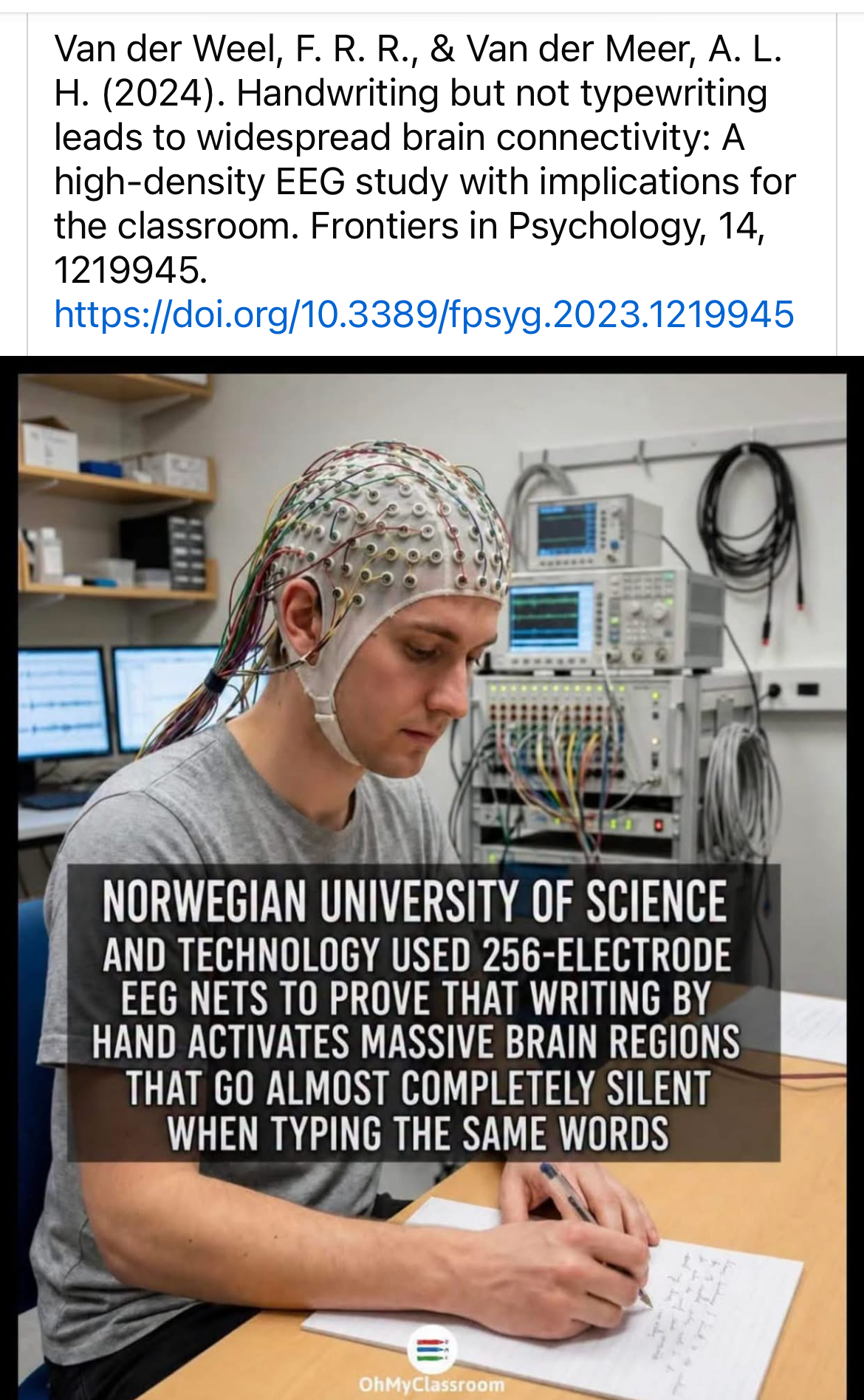
Cool photo, right? One study from 2023 explores what happens in the brain when a person writes by hand versus typing on a device: STUDY.
Citation: Van der Weel FRR and Van der Meer ALH (2024) Handwriting but not typewriting leads to widespread brain connectivity: a high-density EEG study with implications for the classroom. Front. Psychol. 14:1219945. doi: 10.3389/fpsyg.2023.1219945
“Existing literature indicates that connectivity patterns in these brain areas and at such frequencies are crucial for memory formation and for encoding new information and, therefore, are beneficial for learning. Our findings suggest that the spatiotemporal pattern from visual and proprioceptive information obtained through the precisely controlled hand movements when using a pen, contribute extensively to the brain’s connectivity patterns that promote learning” (Abstract).
Yes, I’m a nerd. I love that there is data about how the brain makes connections. Not everyone cares, right? Why do we need these studies?
Evidence 1: For the first time, children are not scoring the same or higher than their parents in education levels.
Here’s a PBS News Special from May 22nd, 2026 featuring William Brangham and Professor Thomas Kane from Harvard University. The term “learning recession” has been applied to American students and this asserts the problem started before the pandemic. To put the problem into numbers, “Compared to a decade ago, math scores today are down in 70 percent of school districts. Reading scores are down in 83 percent” (www.pbs.org/newshour/show/whats-behind-the-decade-long-learning-recession-for-american-students).
Evidence 2: Current college students do not have the stamina for reading or the skills for arithmetic that are necessary to take a university-level class.
Here’s the article in the New York Post from June 11th, 2026 titled, “Professors at top California college forced to radically alter coursework as students struggle to read”
Humanities professors at one of California’s most prestigious universities say they are assigning fewer pages, replacing full books with excerpts and rethinking coursework as students increasingly struggle to keep up with reading-heavy classes.
One of the stand out quotes, “The review follows mounting pressure from more than 1,400 faculty members who argue that many students are entering college without the skills needed for rigorous coursework” (www.nypost.com/2026/06/11/us-news/professors)
Evidence 3: “America’s Reading Crisis That No One Wants To Talk About” Published in Mother Jones on January 23, 2026.
“While 88 percent of parents believe their child is reading at grade level, only roughly 30 percent of students fall into that camp, according to a 2023 Gallup poll” (Mother Jones “America’s Reading Crisis”).
These articles are sounding the alarm that many of our students are not able to read independently and aren’t on grade level. Again, teachers have been saying this anecdotally for years. The good news is that the science of reading also offers solutions.
So, what is my plan?
Luckily, I have an administration that cares about student learning and a level teacher with a ton of experience. We having been increasing analog learning in our classrooms for a hybrid approach – essentially having students take a break from screens and increase hand-eye coordination and multi-sensory skills through physical activities. This also cuts down on the temptation to utilize generative AI.
Is that too jargony?
It means reading a text and annotating it or writing notes by hand instead of typing sticks in the brain better because more connections are made. This doesn’t mean that technology should be eschewed. The above study advises that a hybrid approach allows students to learn more effectively while remaining aware of technological advances. For example, many standardized tests for college admission or College Board credit are only administered via electronic devices and students need to be comfortable and prepared for that assessment modality.
One way we are moving into analog is through a project with Caezik Academic. I put together a workbook that includes the text, vocabulary, journal prompts, discussion questions, and activities. My school will be using the workbook for The Call of the Wild.

I am excited to use these workbooks in my classroom and would be happy to help any other educators who choose to use them. I have also put together a workbook for Frankenstein. As a science fiction/fantasy writer, it was an amazing opportunity to dig into Mary Shelley’s text and ask students to make connections to what is happening with our current relationship to technology. I especially had fun with some of the journal prompts. If interested in either purchasing these workbooks or, if you are an educator, getting more information about creating one for you school, check out Caezik Academic.
While workbooks are not new, they have been largely replaced by digital learning. An emphasis has been placed on making sure every student has a device. Projects were moved from the physical world into the virtual world. For example, instead of making flashcards by hand, several electronic sites popped up to make virtual flashcards. THIS IS NOT BAD. I’ve included all these links to articles to show that this is a nuanced topic. In fact, I’ve had students use these sites for certain activities.
What I don’t like about these sites is that AI is now built in so that students are able to skip the experience of typing out the definitions. This is the learning step before the memorization ability. Instead, the computer guesses (think of autocorrect) what definition should be assigned to the word. Sometimes it is correct; oftentimes, it is not. In English class, the correct definition depends on the time period and context. AI is not able to provide connotation versus denotation and students fall into the trap of trusting AI.
Is a workbook going to fix everything? No, of course not. In fact, I’ve already noticed an error that I made and my level teacher has suggested a visual to include for next year’s edition. We are always tweaking and perfecting so that we can modify for our students. That’s what educators do.
Moving away from screens for everything is a start. And having everything in one workbook cuts down on distractions. No more “forgetting” the book in the locker, no more digging through folders to find worksheets, no more needing to charge laptops. The material is in one place and we can use what we’ve learned about how the brain makes connections to meet students where they are.
Love,
Sherri

 Taste of Sherri